Should You Opt Out of AI Resume Screening?
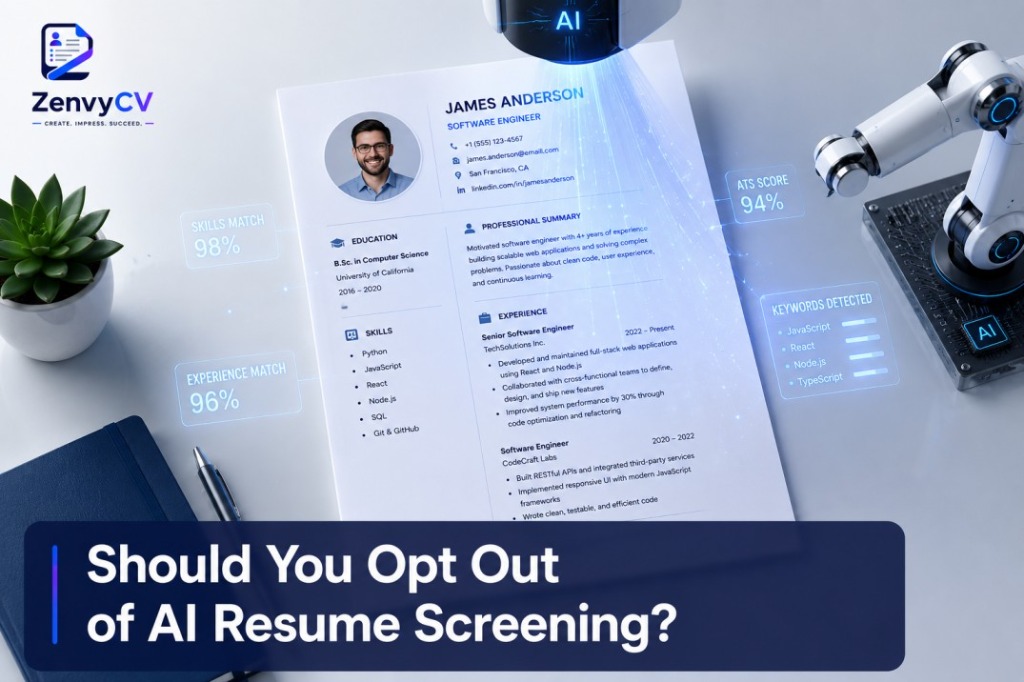
AI resume screening has transformed modern hiring by using machine learning and natural language processing to automatically filter job applications before they reach human recruiters. These automated systems scan resumes for keywords, skills, job titles, and experience that match specific role requirements, processing thousands of applications in minutes—a task that would take human recruiters weeks to complete manually. Roughly 98% of Fortune 500 companies now use some form of AI screening, making it nearly impossible to bypass if you are targeting mid-to-large organizations.
The technology works through a systematic eight-step process: document submission triggers parsing algorithms that extract and standardize your information, keyword matching compares your qualifications against job requirements, machine learning models evaluate your career trajectory and credentials, scoring systems rank you against other applicants, and automated decisions route top candidates to interviews while rejecting low scorers. This brings significant benefits including 75% faster time-to-hire, cost savings of $3,000-$5,000 per hire, consistent evaluation criteria, and 24/7 application processing that eliminates human bottlenecks.
However, AI screening creates serious drawbacks—qualified candidates get rejected for lacking exact keyword matches, creative resume formatting confuses parsing algorithms, systems amplify historical hiring biases, employment gaps trigger automatic penalties, and soft skills remain invisible to algorithms. Most companies don't offer opt-out options, making it essential to understand how these systems work and optimize your resume accordingly. This guide explains what AI resume screening is, how the technology functions step-by-step, its benefits and limitations, and proven strategies to beat automated filters without opting out of the process entirely.
Should You Opt Out of AI Resume Screening?
No—opting out isn't advisable or even possible in most cases. AI resume screening uses machine learning and natural language processing to filter resumes before they reach human recruiters, scanning for keywords, skills, job titles, and experience that match specific role requirements. Opting out isn't typically an option since most companies integrate these tools directly into their applicant tracking systems without offering candidates a choice—you either submit through their portal or don't apply at all.
The technology has become so embedded in corporate hiring infrastructure that roughly 98% of Fortune 500 companies use some form of automated screening, making it nearly impossible to bypass if you are targeting mid-to-large organizations. Some companies provide opt-out options under data privacy or consent settings, but these are rare exceptions rather than standard practice, and exercising this choice often means your resume bypasses the AI system and requires manual review, which could delay your evaluation significantly or exclude you from consideration entirely since some organizations structure their workflows so that human reviewers never encounter applications that skip the automated system.
AI resume screening provides speed and consistency in candidate evaluation—recruiters save time by reviewing only pre-qualified applications, while candidates benefit from faster initial review and fairer comparison when algorithms are properly trained. If you need employment quickly and are applying to numerous positions, submitting through AI systems while optimizing your resume with relevant keywords remains your most efficient path since it lets you cast a wider net where one optimized resume can pass through dozens of ATS filters weekly.
Manual application routes do exist but require significantly more effort than standard portal submissions. You can attempt direct outreach by networking with hiring managers on LinkedIn, attending industry events where recruiters are present, or leveraging employee referrals to get your resume directly into human hands—these methods bypass the initial AI filter entirely and increase your visibility by up to 70% compared to cold applications. Small businesses, startups, and companies with fewer than 50 employees often still rely on manual screening, so targeting these organizations gives you automatic human review without needing to circumvent technology barriers.
The decision to pursue AI-free routes depends on your job search strategy, timeline, and priorities—if you're pursuing specific dream roles or senior positions where relationship-building matters more than volume, investing time in networking and direct outreach yields higher quality opportunities even though it takes three to four times longer per application. However, for most job seekers targeting multiple opportunities across various companies, working within the AI screening system rather than against it produces better results.
Consider a hybrid approach that balances both methods strategically to maximize your job search effectiveness. Submit ATS-optimized resumes to companies you're moderately interested in to maintain application momentum while simultaneously dedicating focused energy toward direct outreach for your top-choice employers—this ensures you're not sacrificing quantity for quality or vice versa. Track which method generates more interviews over a two-month period and adjust your ratio accordingly, since your industry, experience level, and geographic market all influence which approach works better for your specific situation, helping you make informed choices that align with both practical realities of modern hiring processes and your personal career goals.
What Is AI Resume Screening?
AI resume screening is an automated process where artificial intelligence software evaluates job applications by analyzing resumes against specific job requirements, eliminating the need for human recruiters to manually review hundreds or thousands of applications. The technology uses machine learning algorithms and natural language processing to scan documents for relevant keywords, skills, work experience, education credentials, and other qualifications that match the employer's predetermined criteria. Modern AI screening systems can parse resumes in various formats—including PDFs, Word documents, and plain text files—extracting structured data from unstructured content while identifying patterns that indicate a candidate's potential fit for a role.
These systems assign scores or rankings to each application based on how closely the candidate's background aligns with the job description, automatically filtering out applicants who don't meet minimum requirements while flagging top candidates for human review. AI resume screeners examine multiple data points simultaneously: years of experience in specific roles, technical competencies, industry certifications, educational background, career progression patterns, and even linguistic indicators of soft skills mentioned throughout the document. The software operates on rules-based logic combined with machine learning models that have been trained on thousands of successful hires, enabling it to recognize which candidate attributes correlate with job performance in particular positions.
How Does AI Resume Screening Work?
AI resume screening follows a systematic, step-by-step process that transforms unstructured application documents into ranked candidate lists through multiple technological layers working in coordinated sequence.
Document Submission and Intake
The process begins when a candidate submits their resume through an applicant tracking system or career portal, triggering immediate file reception where the software accepts various formats including PDF, DOCX, TXT, and sometimes HTML files while assigning each application a unique identifier for tracking purposes. The system timestamps the submission, associates it with the specific job posting, and queues the document for automated processing alongside potentially hundreds or thousands of other applications received for the same position.
Document Parsing and Data Extraction
The AI deploys parsing technology that reads the resume file and converts it from its original format into structured, machine-readable data by identifying text content, recognizing document layout patterns, and separating different information sections. Optical character recognition technology processes scanned documents or image-based PDFs by converting visual text into digital characters, while natural language processing engines analyze the extracted text to identify semantic meaning, contextual relationships, and organizational structure. The parser locates and categorizes standard resume components—contact information gets extracted into dedicated fields for name, email, phone number, and location; work experience sections are broken down into company names, job titles, employment dates, and responsibility descriptions; education history is separated into institutions, degrees, graduation dates, and GPAs; skills lists are identified and itemized individually.
Information Standardization and Normalization
The extracted data undergoes normalization where the AI converts varied formats into consistent standards—date formats like "Jan 2020," "01/2020," and "January 2020" all become uniform entries; job titles with different phrasings like "Software Dev," "Software Developer," and "SWE" are recognized as equivalent roles; company name variations such as "IBM," "International Business Machines," and "I.B.M." are unified into single entities. The system calculates derived metrics including total years of experience, duration at each position, gaps in employment history, and time since degree completion, storing these computed values as additional data points for evaluation.
Keyword and Requirements Matching
The AI compares extracted resume content against the job description's required and preferred qualifications by searching for specific keywords, technical skills, certifications, educational credentials, and experience indicators that the employer has designated as evaluation criteria. The matching algorithm identifies not just exact keyword occurrences but also uses semantic understanding to recognize related terms—finding "JavaScript" when the job requires "JS," identifying "team leadership" when searching for "management experience," or recognizing "budget oversight" as evidence of "financial responsibility." Context-aware analysis determines whether keywords appear in meaningful contexts: the system distinguishes between a candidate who "used Python" in a project versus one who "architected Python-based enterprise systems," assigning different relevance scores based on the depth and context of keyword usage.
Machine Learning Model Evaluation
Pre-trained machine learning models analyze the standardized candidate data against patterns learned from historical hiring outcomes, evaluating factors that statistically correlate with successful job performance in similar roles. These models assess career trajectory by examining whether the candidate shows upward progression through increasingly responsible positions, lateral movement indicating diverse experience, or stagnation suggesting limited growth. The AI evaluates employer prestige and relevance by comparing previous companies against industry standards, competitors, or adjacent sectors that provide transferable experience. Educational pedigree analysis considers institution rankings, degree relevance to the role, and recency of graduation, while certification validation confirms that credentials are current, recognized, and applicable to the position requirements.
Scoring and Ranking
The system generates numerical scores or categorical ratings for each candidate by applying weighted formulas where different qualifications contribute varying point values to an overall assessment—a required certification might be worth 20 points, relevant experience adds points proportional to years worked, and preferred skills each contribute smaller incremental values. Candidates receive composite scores that position them within the applicant pool, with the AI creating ranked lists that order applications from highest to lowest match quality. Some systems use tier classification instead of or in addition to numerical scores, grouping candidates into categories like "strongly recommended," "qualified for review," "marginal fit," and "does not meet requirements" based on threshold scores or rule-based logic.
Automated Decision Making and Workflow Routing
Based on scores and rankings, the AI executes predetermined actions: top-scoring candidates automatically advance to the next recruitment stage, triggering notifications to hiring managers and scheduling interview invitations; mid-tier candidates enter a hold status for potential review if higher-ranked applicants decline; low-scoring applications receive immediate automated rejection emails explaining that their qualifications don't align with position requirements. The system updates the applicant tracking database with evaluation results, maintains audit trails showing which criteria influenced each decision, and generates recruiter dashboards displaying candidate pipelines, screening statistics, and recommendations for human review priorities.
Continuous Learning and Model Refinement
Advanced AI screening systems monitor hiring outcomes by tracking which screened candidates received offers, accepted positions, and performed successfully during employment, feeding this outcome data back into machine learning models to refine future screening accuracy. The AI identifies which resume characteristics actually predicted job success versus which were false indicators, adjusting scoring weights and evaluation criteria accordingly—if candidates from non-traditional educational backgrounds consistently perform well, the system reduces emphasis on institutional prestige; if specific keyword combinations correlate with early turnover, those patterns trigger cautionary flags. This feedback loop enables the screening algorithm to improve over time, theoretically becoming more accurate at predicting candidate-job fit as it processes more applications and observes more hiring outcomes.
What are the Benefits of AI Resume Screening?
⚡ Speed and Efficiency
AI resume screening processes thousands of applications in minutes, a task that would take human recruiters weeks to complete manually. Companies reduce time-to-hire by 75% on average when using automated screening systems, allowing them to fill positions faster and keep top candidates engaged before competitors make offers.
💰 Cost Reduction
Organizations save between $3,000 and $5,000 per hire by automating initial resume reviews, eliminating the need for large recruiting teams to manually sort through every application. This cost efficiency allows companies to allocate recruiting budgets toward candidate experience improvements, employer branding, and better assessment tools for final-stage interviews.
⚖️ Consistency and Standardization
AI screening evaluates every resume using identical criteria, eliminating day-to-day mood variations, unconscious biases, and subjective preferences that affect human reviewers. Each candidate receives assessment based purely on qualifications match rather than whether the recruiter reviewing their application had a good morning or felt fatigued after reading 200 resumes.
🔍 Keyword Matching & Skills ID
Automated systems identify specific technical skills, certifications, and experience requirements with precision that humans might miss during quick manual scans. The technology recognizes synonyms and related terms—understanding that "customer service" matches with "client relations" or that "Python programming" relates to "software development"—creating more comprehensive candidate matching.
⏱️ 24/7 Application Processing
AI screening works continuously without breaks, processing applications immediately after submission regardless of time zones or business hours. Candidates receive faster initial responses, and companies avoid application backlogs that occur when human teams are overwhelmed or out of office.
📈 Scalability for High-Volume
Organizations hiring for multiple positions simultaneously or conducting seasonal hiring campaigns manage application surges without proportionally expanding recruiting staff. A single AI system handles whether you receive 50 applications or 5,000 applications with the same processing speed and accuracy.
What are the Drawbacks of AI Resume Screening?
-
⚠️
Keyword Over-Reliance AI systems often reject qualified candidates whose resumes lack exact keyword matches even when their experience clearly demonstrates relevant capabilities. A candidate with "managed customer relationships" might get filtered out when the system searches specifically for "CRM software experience," missing qualified applicants who possess the underlying skill but described it differently.
-
⚠️
Resume Format Limitations Creative resume designs, infographics, tables, text boxes, and non-standard formatting confuse parsing algorithms, causing them to misread or completely skip qualified candidates' information. Applicants with visually appealing resumes optimized for human readers often score lower than those using plain-text ATS-friendly formats, penalizing design-conscious professionals.
-
⚠️
Bias Amplification AI screening systems trained on historical hiring data perpetuate existing workplace biases by learning to favor demographic patterns present in past successful hires. Studies show these algorithms discriminate against candidates with ethnic-sounding names, employment gaps common among caregivers, or educational backgrounds from less prestigious institutions, replicating rather than reducing human bias.
-
⚠️
Missing Context and Nuance Automated systems cannot evaluate career progression narratives, understand why someone made strategic lateral moves, or recognize transferable skills from non-traditional backgrounds. A career changer with highly relevant volunteer experience or a military veteran with applicable leadership training often gets rejected because AI cannot interpret how their unique background translates to civilian job requirements.
-
⚠️
Penalizing Career Gaps AI screening frequently filters out candidates with employment gaps without considering legitimate reasons like parenting, caregiving, education, medical issues, or economic downturns. The algorithms treat any resume gap as a negative signal, disproportionately affecting women, caregivers, and professionals who took time for skill development or personal circumstances.
-
⚠️
Generic Job Hopping Penalties Systems automatically downgrade candidates with frequent job changes without distinguishing between unstable work history and legitimate reasons like contract positions, layoffs, company closures, or strategic career advancement. Younger professionals building experience through multiple short-term roles or workers in volatile industries face unfair rejection despite strong performance records.
-
⚠️
Limited Soft Skills Assessment AI cannot evaluate communication abilities, emotional intelligence, cultural fit, problem-solving approaches, or leadership potential that emerge during human conversations. Critical qualities like adaptability, creativity, teamwork, and initiative remain invisible to algorithms that only process text-based credentials and quantifiable experience markers.
-
⚠️
Technical Errors and Glitches Parsing failures misread dates, confuse education with experience sections, or incorrectly categorize skills, causing qualified candidates to receive low scores due to technical mistakes rather than actual qualification gaps. These errors occur silently without candidate knowledge, providing no opportunity to correct misinterpretations that cost them interview opportunities.
How to Beat AI Screening Without Opting Out?
Optimize for ATS-Friendly Formatting
Use standard resume formats with simple, clean layouts that parsing software reads accurately—stick to common fonts like Arial, Calibri, or Times New Roman in 10-12 point size, avoid tables, text boxes, headers, footers, and graphics that confuse algorithms. Save your resume as a .docx or PDF file (check the job posting for preferred format) since these file types parse more reliably than other formats, and use standard section headings like "Work Experience," "Education," and "Skills" that ATS systems recognize immediately.
Mirror Job Description Language
Extract keywords directly from the job posting and incorporate them naturally throughout your resume, matching the exact terminology employers use rather than synonyms—if they say "project management," use "project management" instead of "project coordination." Identify required skills, qualifications, certifications, and technical tools mentioned in the posting and ensure your resume includes these terms in context where you genuinely possess those capabilities, but never lie or fabricate experience just to game the system.
Use Industry-Standard Job Titles
Replace creative or company-specific job titles with standardized versions that ATS systems recognize—if your official title was "Happiness Engineer" but you did customer support work, list "Customer Support Specialist" to match what algorithms search for. Include your official title in parentheses if needed for accuracy (e.g., "Customer Support Specialist (Happiness Engineer)") so you maintain honesty while optimizing for keyword matching.
Quantify Achievements with Metrics
Include specific numbers, percentages, dollar amounts, and measurable outcomes throughout your experience descriptions since AI systems often prioritize resumes containing quantifiable results. Write "increased sales by 35% over six months" instead of "significantly improved sales performance" or "managed $2M budget across 12 projects" rather than "handled large budget responsibilities"—concrete metrics pass through filters more effectively than vague accomplishment statements.
Include a Skills Section with Exact Matches
Create a dedicated skills section listing technical proficiencies, software programs, methodologies, and certifications using exact names from the job description—this gives ATS systems a concentrated keyword-rich area to scan. List skills like "Salesforce CRM," "Google Analytics," "Agile methodology," and "PMP certification" as precise matches rather than grouped categories, ensuring the algorithm identifies each specific capability it's programmed to find.
Avoid Abbreviations Without Spelling Out Terms
Write out acronyms and abbreviations with their full versions on first use to ensure ATS systems recognize both formats—use "Search Engine Optimization (SEO)" instead of just "SEO" and "Bachelor of Science (B.S.)" rather than only "B.S." Some algorithms search only for full terms while others look only for abbreviations, so including both versions guarantees your qualifications get detected regardless of which variant the system seeks.
Customize Each Application
Tailor your resume for every specific job application rather than submitting one generic version to multiple positions—this takes more time but dramatically increases your pass-through rate since each role searches for different keyword combinations. Identify the 8-10 most critical requirements from each job posting and ensure your resume addresses these priorities prominently, repositioning or rewording existing experience to align with what each specific employer values most.
Use Action Verbs That Match Job Requirements
Start bullet points with strong action verbs that appear in the job description—if the posting emphasizes "develop," "implement," or "optimize," use these exact verbs when describing your relevant accomplishments. AI systems often weight matching action verbs as signals of aligned experience, so "developed training programs" scores higher when the posting says "develop training initiatives" than synonyms like "created" or "built" would.
Include Relevant Certifications and Education
List all certifications, licenses, degrees, and continuing education that relate to the position prominently in dedicated sections since these often serve as minimum qualification filters that automatically reject candidates lacking them. Use full official names for degrees and certifications (e.g., "Project Management Professional (PMP)" not just "PMP certified" and "Master of Business Administration (MBA)" not "graduate degree") to ensure algorithms recognize your credentials.
Test Your Resume Through ATS Simulators
Run your resume through free online ATS scanning tools like Jobscan, Resume Worded, or SkillSyncer before submitting to see how well it matches specific job descriptions and identify missing keywords. These simulators show you match percentages and highlight gaps between your resume and the posting, allowing you to adjust language and add relevant terms that increase your chances of passing employer screening systems.