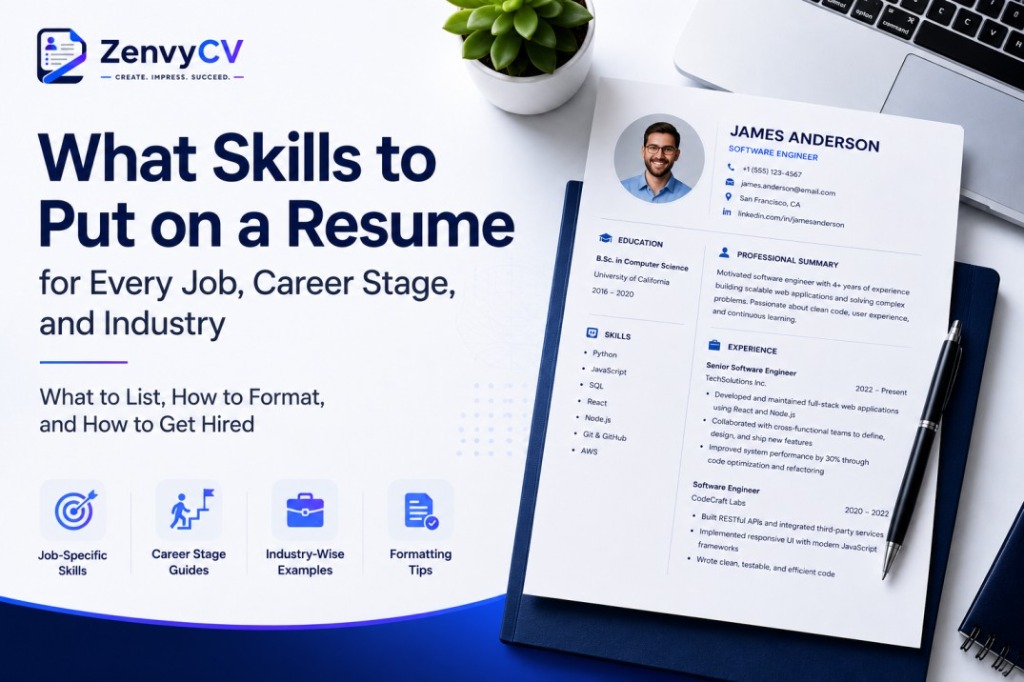
What Skills to Put on a Resume for Every Job, Career Stage, and Industry: What to List, How to Format, and How to Get Hired
Your resume has about 20 seconds to make an impression. In that window, your skills section does more work than almost anything else on the page. It tells a hiring manager whether you can do the job, signals to ATS software whether your application is worth reviewing, and sets the tone for everything that follows.
But knowing that skills matter is not the same as knowing which skills to list, how to present them, or where to place them on the page. That's exactly what this guide covers.
We start with the fundamentals: the difference between hard skills, soft skills, and technical skills, and why the right balance of all three makes a resume stand out. From there, we break down the best skills for over 20 professions, from software engineers and nurses to cashiers, caregivers, warehouse workers, and research assistants. Each profession comes with a ready-to-use example skills section you can adapt immediately.
We also cover how your career stage changes everything. A high school student applying for their first job needs a very different approach than an experienced professional pivoting industries, and this guide addresses both, along with every stage in between.
Beyond the lists, you'll find guidance on skill types that cut across every role: leadership, communication, problem-solving, computer skills, language proficiency, and customer service. Each section includes concrete examples of how to phrase skills so they show impact, not just familiarity.
Finally, we cover the mistakes that get resumes rejected and the strategies that get them read.
What Are Resume Skills?
Resume skills are the abilities and competencies you bring to a job. They tell an employer what you can do, not just where you've worked. Every skill on your resume falls into one of two buckets: hard skills or soft skills. Hard skills are technical and job-specific, such as Python, financial modeling, or patient triage. Soft skills are interpersonal and behavioral, such as communication, problem-solving, and adaptability.
Skills act as a quick signal for hiring managers scanning your resume. Research shows that 74% of recruiters spend 20 seconds or less skimming a resume before deciding whether to read it. In that window, the skills section is one of the fastest signals a hiring manager has: does this person match what we need?
Skills also function as keywords. When companies use Applicant Tracking Systems (ATS) to screen applications, your skills section is one of the first places those systems scan. The right skills, in the right words, get your resume in front of a real person.
What Types of Skills Should You Put on a Resume?
There are three main types of skills every resume should include:
🔧 Hard Skills
Technical, teachable, and measurable. Gained through education, training, or hands-on experience. Examples: data analysis, coding, accounting, or operating medical equipment. They show employers you can perform the core tasks of a role.
🤝 Soft Skills
Behavioral and interpersonal. They describe how you work, think, and communicate. Many employers call these durable skills because they stay relevant across roles, industries, and changing job requirements.
💻 Technical Skills
A subset of hard skills tied specifically to tools, platforms, and systems. Examples: Excel, Salesforce, AutoCAD, or programming languages like Python or SQL.
The ideal skills balance: Research shows that the ideal resume includes 60% hard skills and 40% soft skills. This balance demonstrates both technical competence and the ability to collaborate effectively.
What Are the Best Skills to Put on a Resume?
The best skills are the ones most relevant to the job you're applying for. That said, certain skills consistently rank as high-value across industries.
🔩 Top Hard Skills in Demand
- Data analysis and data visualization (Excel, Tableau, Power BI, SQL)
- Programming (Python, JavaScript, Java)
- Project management (Agile, Scrum, PMP)
- Cloud platforms (AWS, Azure, Google Cloud)
- AI and machine learning tools
- Financial modeling and budgeting
- SEO, content marketing, and PPC
- CRM platforms (Salesforce, HubSpot)
💬 Top Soft Skills in Demand
Communication is the most-requested soft skill, appearing in nearly 1.9 million job postings in December 2024 alone. Beyond communication:
- Critical thinking
- Problem-solving
- Adaptability
- Collaboration and teamwork
- Leadership and people management
- Emotional intelligence
- Time management
AI is changing everything. Generative AI expertise is one of the fastest-growing technical skills. Employers expect that 39% of key skills required in the job market will change by 2030, according to the World Economic Forum's Future of Jobs Report 2025. Keeping your skills section updated is not optional — it is essential.
Resume Skills by Profession
Administrative Assistant
Administrative assistants keep offices running efficiently. The role demands a mix of organizational precision and interpersonal polish.
Tools: Microsoft Office Suite (Word, Excel, Outlook), Google Workspace, SharePoint, Zoom | Operations: Calendar Management, Travel Coordination, Expense Reporting, Document Preparation | Soft Skills: Attention to detail, discretion, multitasking, professional communication
Customer Service
Customer service roles require the ability to resolve issues quickly while keeping interactions positive, across channels including phone, email, and live chat.
Tools: Zendesk, Salesforce CRM, Freshdesk, Live Chat | Service Skills: Issue Resolution, Order Processing, Complaint Handling, Upselling | Metrics: CSAT Tracking, First-Call Resolution, Average Handle Time | Soft Skills: Active listening, empathy, patience, conflict de-escalation
Retail
Retail positions require customer-facing competence combined with operational accuracy on the floor and at the register.
Operations: POS Systems (Square, Lightspeed), Inventory Management, Cash Handling, Merchandising | Sales: Product Knowledge, Upselling, Customer Assistance, Loss Prevention Awareness | Soft Skills: Friendliness, persuasion, team collaboration, adaptability
Sales
Sales roles demand a structured approach to prospecting, closing, and retaining accounts, backed by strong relationship-building skills.
Sales Process: Lead Generation, Pipeline Management, Consultative Selling, Negotiation, Closing | Tools: Salesforce, HubSpot CRM, LinkedIn Sales Navigator | Performance: Quota Attainment, Account Management, CRM Reporting | Soft Skills: Persuasion, resilience, active listening, relationship building
Receptionist
Receptionists are the first point of contact for an organization. The role blends front-desk operations with scheduling and communication.
Front Desk: Visitor Management, Multi-line Phone Handling, Mail Coordination, Appointment Scheduling | Tools: Microsoft Outlook, Calendly, Google Workspace | Soft Skills: Professionalism, clear communication, composure, discretion
Cashier
Cashier roles are built around transaction accuracy, speed, and positive customer interaction during checkout.
Transactions: Cash Handling, POS Operation (Square, NCR), Returns Processing, Drawer Balancing | Operations: Barcode Scanning, Receipt Management, Inventory Assistance | Soft Skills: Accuracy, efficiency, friendliness, composure during rush periods
Waiter / Waitress / Server
Server roles require a seamless combination of hospitality, memory, and coordination in fast-paced environments.
Service: Order Taking, Table Management, Upselling, Complaint Resolution, Food & Beverage Knowledge | Tools: Toast POS, OpenTable, Square for Restaurants | Soft Skills: Attentiveness, multitasking, composure under pressure, team coordination
Banking
Banking professionals handle financial transactions, customer accounts, and regulatory compliance at varying levels of seniority.
Banking Operations: Account Management, Transaction Processing, Loan Processing, Fraud Detection | Compliance: KYC, AML Procedures, Regulatory Reporting | Tools: FIS, Temenos, Excel (Advanced) | Soft Skills: Numerical accuracy, confidentiality, client relationship management
Accounting
Accounting professionals manage financial records, ensure compliance, and produce reports that drive business decisions.
Accounting: General Ledger, Accounts Payable/Receivable, Bank Reconciliation, Financial Reporting | Compliance: GAAP, Tax Preparation, Audit Support | Tools: QuickBooks, Xero, SAP, Excel (Advanced) | Soft Skills: Analytical thinking, attention to detail, integrity, deadline management
Human Resources
HR professionals recruit, develop, and retain talent while ensuring legal compliance and a healthy workplace culture.
HR Functions: Talent Acquisition, Onboarding, Performance Management, Employee Relations, Benefits Administration | Compliance: HR Policy, Employment Law, DEI Initiatives | Tools: Workday, BambooHR, Greenhouse, ADP | Soft Skills: Empathy, confidentiality, conflict resolution, clear communication
Marketing
Marketing professionals develop and execute strategies to build brand awareness and drive revenue.
Analytics & Ads: Google Analytics, Meta Ads Manager, PPC, A/B Testing | Content: SEO, SEM, Copywriting, Content Strategy | Tools: HubSpot, Mailchimp, Semrush, Canva | Soft Skills: Brand storytelling, cross-team collaboration, data-driven decision-making
Teacher / Educator
Teachers design learning experiences, manage classroom dynamics, and track student progress across diverse learning needs.
Instruction: Curriculum Design, Differentiated Instruction, IEP Development, Lesson Planning | Tools: Google Classroom, Canvas, SMART Board | Assessment: Student Progress Tracking, Standardized Reporting | Soft Skills: Classroom management, parent communication, patience, adaptability
Nursing
Nurses deliver direct patient care, coordinate with care teams, and manage complex clinical situations under pressure.
Clinical: Patient Assessment, IV Insertion, Wound Care, Medication Administration, Critical Care | Systems: Epic EMR, Cerner | Certifications: BLS, ACLS Certified | Soft Skills: Compassion, clinical judgment, composure under pressure, care coordination
Healthcare (General)
Healthcare workers across roles share a foundation of patient-centered care, safety compliance, and clinical documentation.
Patient Care: Vital Signs Monitoring, Infection Control, HIPAA Compliance, Care Coordination | Systems: EHR/EMR Platforms, Medical Billing (ICD-10, CPT) | Soft Skills: Empathy, attention to detail, cross-team communication, adaptability
Pharmacy Technician
Pharmacy technicians support pharmacists in dispensing medications accurately and efficiently while managing inventory and patient records.
Pharmacy Operations: Prescription Processing, Medication Dispensing, Compounding, Inventory Management | Billing: Insurance Adjudication, NDC Verification, Prior Authorization | Tools: QS/1, PioneerRx, Rx30 | Soft Skills: Accuracy, confidentiality, patient communication, efficiency
Medical Assistant
Medical assistants support physicians with both clinical and administrative tasks in outpatient and clinical settings.
Clinical: Vital Signs, Phlebotomy, EKG, Patient Intake, Specimen Collection | Administrative: Appointment Scheduling, Medical Billing, CPT/ICD-10 Coding | Tools: Epic, eClinicalWorks | Soft Skills: Compassion, reliability, attention to detail, professional communication
Caregiver
Caregivers provide personal, physical, and emotional support to individuals who need assistance with daily living.
Care Services: Personal Care Assistance, Medication Reminders, Meal Preparation, Mobility Support | Safety: CPR/BLS Certified, First Aid, Safety Monitoring | Soft Skills: Patience, empathy, dependability, family communication, composure under pressure
Software Engineer
Software engineers design, build, and maintain software systems using a blend of language proficiency and systems thinking.
Languages & Frameworks: Python, JavaScript, React, Java | Tools & DevOps: Git, Docker, MySQL, CI/CD Pipelines | Cloud: AWS, Azure | Methodologies: Agile, Scrum, Code Review | Soft Skills: Problem-solving, cross-functional collaboration, technical documentation
Computer Science
Computer science roles span research, development, and systems design. The skills required go deep into theory and applied engineering.
Programming: Python, C++, Java, R, SQL | Systems: Linux, Git, Cloud Platforms (AWS/GCP) | Specializations: Data Structures, Algorithms, Machine Learning, Database Design | Soft Skills: Logical reasoning, technical writing, team collaboration
IT Professional
IT professionals maintain infrastructure, support end users, and protect organizational systems and data.
Infrastructure: Windows Server, Active Directory, Linux, VMware, Cisco Networking | Support: Helpdesk (ServiceNow), Hardware Troubleshooting, Patch Management | Security: Endpoint Protection, VPN Management, Access Control | Soft Skills: Problem-solving, user communication, documentation, adaptability
Graphic Designer
Graphic designers create visual content for digital and print media, translating briefs into compelling, on-brand designs.
Design Tools: Adobe Photoshop, Illustrator, InDesign, Figma, After Effects | Specializations: Typography, Brand Identity, Motion Graphics, UI/UX | Design Process: Creative Briefs, Client Collaboration, Feedback Integration | Soft Skills: Attention to detail, creative problem-solving, time management
Construction
Construction workers and supervisors require physical competence, safety knowledge, and project coordination skills.
Trade Skills: Blueprint Reading, Framing, Concrete Work, Site Preparation, Quality Inspection | Safety: OSHA 10/30 Certified, Hazard Identification, PPE Compliance | Equipment: Power Tools, Heavy Machinery Operation, Laser Levels | Soft Skills: Reliability, team coordination, physical stamina, on-site problem-solving
Warehouse Worker
Warehouse workers keep supply chains moving through accurate receiving, storage, picking, packing, and shipping.
Operations: Receiving, Shipping, Order Picking & Packing, Inventory Counting, Forklift Operation | Systems: WMS (SAP, Manhattan), RF Scanners | Safety: OSHA Compliance, Forklift Certified, Hazard Awareness | Soft Skills: Reliability, physical endurance, attention to detail, team coordination
Research Assistant
Research assistants support academic or industry research through data collection, analysis, literature review, and project coordination.
Research Methods: Literature Review, Data Collection, Experimental Support, Survey Design | Analysis Tools: SPSS, R, Python, Excel, NVivo | Writing: Academic Writing, Report Writing, Citation Management (Zotero, EndNote) | Soft Skills: Critical thinking, attention to detail, intellectual curiosity, deadline management
Resume Skills by Career Stage
👨🎓 Students
Students entering the job market for the first time should lead with skills gained through coursework, academic projects, and extracurricular involvement. The goal is to show potential through demonstrated ability, not years of experience.
Focus on:- Course-specific technical skills (Excel, Python, AutoCAD, Photoshop — whatever the degree demands)
- Research and writing skills developed through academic work
- Collaboration and teamwork from group projects or labs
- Leadership from student organizations, clubs, or volunteer roles
- Any internship or co-op skills, even if short-term
🏫 High School Students
High school students applying for part-time jobs, internships, or summer positions should focus on transferable skills that employers value even without formal work experience.
Focus on:- Basic computer skills (Microsoft Office, Google Workspace, typing speed)
- Communication and teamwork from class projects or clubs
- Customer-facing skills if you've worked in retail, food service, or volunteering
- Sports, arts, or extracurriculars that demonstrate discipline, teamwork, or leadership
- Any certifications, such as CPR/First Aid or Google Career Certificates
🎓 College Students
College students should blend academic technical skills with early professional experience from internships, part-time jobs, or research roles.
Focus on:- Tools and software from your major (e.g., Python for CS majors, SPSS for psychology, AutoCAD for engineering)
- Internship-acquired skills, listed with the specific tool or task
- Research skills if relevant to the target role
- Leadership and initiative from campus organizations, hackathons, or case competitions
- Relevant certifications earned independently (Google Analytics, HubSpot, AWS Cloud Practitioner, Bloomberg Market Concepts)
🌱 Freshers
Freshers — recent graduates with little or no formal work experience — need their skills section to do the work that experience cannot yet do. Specificity and relevance matter more than length.
Focus on:- Practical tools from coursework or self-study (Excel, Python, Canva, Figma, SQL)
- Project-based skills, even from academic or personal projects
- Certifications that signal initiative and domain knowledge
- Multilingual ability, especially for roles involving client communication
- Foundational soft skills backed by concrete examples, not vague claims
💼 First Job
Candidates applying for their first formal job — whether after a career gap, a degree, or a non-traditional path — should treat skills as proof of readiness rather than a list of credentials.
Focus on:- Transferable skills from volunteer work, freelance projects, or personal ventures
- Any formal or informal training completed (online courses, bootcamps, workshops)
- Technology comfort level — even general digital proficiency matters for many entry-level roles
- Organizational and communication skills demonstrated through real situations
- Relevant certifications, even self-paced ones from Coursera, LinkedIn Learning, or Google
🚫 No Experience
Candidates with no formal work experience should not leave the skills section empty or generic. Skills can come from many places beyond paid employment.
Sources of legitimate skills:- Volunteer work and community service
- Personal projects (a blog, a built website, a YouTube channel, a self-managed business)
- Academic achievements and relevant coursework
- Self-directed learning and certifications
- Caregiving, household management, or other life experience that develops real competencies
🏆 Experienced Professionals
Mid-career and senior professionals should treat the skills section as a curated summary of their highest-value competencies — not a comprehensive list of everything they know.
Focus on:- Skills that directly match the target role's requirements
- Tools and platforms currently in use, not outdated ones
- Leadership, strategy, and cross-functional skills that reflect seniority
- Specialized expertise that differentiates you from generalists
- Remove skills tied to work you want to move away from
For senior professionals, the skills section should be concise. Your work history carries more weight; the skills section reinforces, not replaces, that story.
Executive-level priorities:- P&L management, organizational development, change management
- Executive communication and board-level stakeholder relations
- Mergers, acquisitions, or enterprise-scale operations
- Strategic planning and cross-functional leadership
Resume Skills Examples
Technical Skills Examples
Technical skills are tool- and system-specific. List them with enough precision that a recruiter or ATS can recognize them.
📊 Data & Analytics
⚙️ Engineering & Dev
☁️ Cloud & Infrastructure
🎨 Design
💰 Finance & Accounting
🏥 Healthcare
📣 Marketing
Soft Skills Examples
Soft skills are most effective when anchored to concrete situations rather than listed in isolation.
| Soft Skill | How to Show It on a Resume |
|---|---|
| Communication | "Presented monthly KPI reports to 50+ stakeholders across 4 departments" |
| Leadership | "Led a cross-functional team of 8 to deliver a product launch 2 weeks ahead of schedule" |
| Problem-solving | "Diagnosed and resolved a recurring system error that had caused 3 hours of weekly downtime" |
| Adaptability | "Transitioned team workflows to remote operations within 48 hours during COVID-19 restrictions" |
| Teamwork | "Collaborated with design, engineering, and marketing to ship 3 product features per quarter" |
| Time management | "Managed 6 concurrent client accounts with 100% on-time delivery over 18 months" |
| Attention to detail | "Reviewed 200+ contracts per month with a zero-error rate over two audit cycles" |
| Critical thinking | "Identified a pricing inconsistency that saved the company $40K annually" |
Computer Skills Examples
Over 70% of jobs today require medium-to-high-level digital competency. List computer skills specifically — name the software, not just the category.
📄 Office Productivity
💬 Collaboration
📊 Data & Reporting
🎨 Design & Creative
🛒 CRM & Sales
🏭 Industry-Specific
Language Skills Examples
List languages with a recognized proficiency level to give employers a clear picture of how you can use them on the job.
| Proficiency Level | What It Means |
|---|---|
| Native / Mother Tongue | Your first language, used fluently in all contexts |
| Fluent / Full Professional | Can work, present, and negotiate in this language |
| Professional Working | Can handle routine work tasks and correspondence |
| Conversational | Can communicate in everyday situations; not for complex professional use |
| Basic / Elementary | Limited understanding; not suitable for professional settings |
Include language skills when the role involves international clients, multilingual markets, or teams across regions. A language skill can be a meaningful differentiator even if it is not listed in the job description.
Leadership Skills Examples
Leadership skills apply at every level — not just management. Demonstrate them through outcomes, not titles.
How to frame leadership on a resume:
- "Mentored 4 junior analysts over 18 months; 2 were promoted within the year"
- "Led a 12-person cross-functional team to deliver a platform migration on schedule and 10% under budget"
- "Redesigned the onboarding process, reducing new hire ramp time from 8 weeks to 5"
Communication Skills Examples
Communication is the most-requested skill on resumes — which also makes it the most overused. Make it specific.
✍️ Written
Reports, emails, proposals, documentation
🗣️ Verbal
Presentations, client calls, team briefings
🎤 Public Speaking
Conferences, town halls, training delivery
🤝 Interpersonal
One-on-one feedback, negotiation, active listening
🌍 Cross-cultural
Working across time zones, languages, or organizational levels
Show it — don't just say it:
- "Authored weekly internal newsletter read by 300+ employees"
- "Delivered product demos to enterprise clients, contributing to $1.2M in closed deals"
- "Facilitated monthly all-hands meetings for a 60-person team"
Customer Service Skills Examples
Customer service skills span both the technical tools used and the interpersonal qualities that define the experience.
🛠️ Technical / Tool-Based
- CRM: Salesforce Service Cloud, Zendesk, Freshdesk, HubSpot
- Ticketing systems and helpdesk software
- Live chat tools (Intercom, Drift, LiveChat)
- Knowledge base management
- POS systems for retail or hospitality
💬 Interpersonal / Behavioral
- Active listening and empathy
- Complaint handling and de-escalation
- Product and service knowledge
- First-call resolution
- Follow-up and relationship retention
- Upselling and cross-selling
How to frame on a resume:
- "Maintained a CSAT score of 96% across 500+ monthly interactions"
- "Resolved an average of 80 support tickets per day with a first-response time under 2 hours"
Problem-Solving Skills Examples
Problem-solving is a top-demanded soft skill, but it only lands if you show the problem and the outcome.
How to demonstrate it:
- "Identified a billing error affecting 200+ accounts and built a reconciliation tool in Excel, recovering $85K in outstanding revenue"
- "Reduced customer complaint rate by 22% by redesigning the returns process after root cause analysis"
- "Diagnosed and fixed a critical production bug within 4 hours, preventing an estimated $30K in service downtime"
Resume Skills Examples by Job
Customer Service Resume
Administrative Assistant Resume
Retail Resume
Teacher Resume
Nursing Resume
Software Engineer Resume
Marketing Resume
Accounting Resume
How Do You Choose the Right Skills for Your Resume?
Analyze the job posting. Look for repeated words and phrases. Skills that appear multiple times are the employer's priorities. Mirror their exact language, not a synonym.
Match your genuine abilities. Only list skills you can discuss confidently in an interview. Include only what you're actually confident doing.
Check industry standards. Search job listings, scan LinkedIn profiles of people in similar roles, and consult career sites like O*NET Online or the Bureau of Labor Statistics for a broader picture of what's standard in your target role.
Remove outdated skills. Including old tools or tech you haven't used recently can make your experience look out of date. Stick to what you actually use day to day.
Skip skills you want to leave behind. If you include skills tied to work you're trying to move away from, you'll end up doing more of that same work.
How Should You List Skills on a Resume?
Where to Place Your Skills Section
In a reverse-chronological resume (the most common format), list your skills after your work experience. This keeps the focus on your career history while still highlighting key qualifications. Entry-level candidates can place skills higher if work experience is thin.
How to Format the Skills Section
Grouping beats flat lists. A comma-separated list of 15 skills is harder to scan than a categorized two-column layout. Grouping also signals to both ATS and human reviewers that your skills cluster into coherent domains.
Technical: Python, SQL, Tableau, Excel (Advanced)
Project Management: Agile, Scrum, Jira, MS Project
Soft Skills: Cross-functional communication, stakeholder management, analytical thinking
How Many Skills to Include
The optimal range is 8–12 skills that directly mirror the language of the specific job posting. Listing 20+ skills dilutes your signal and can read as padding. Listing 4–5 skills leaves keyword-match potential untapped.
Back Skills Up with Context in Your Experience Section
Do not just list "data analysis." Show it in action:
What Resume Skills Mistakes Should You Avoid?
A strong skills section can open doors, but common mistakes can quietly close them before a recruiter ever reaches your experience.
- ❌Using generic, vague terms. "Hardworking," "team player," and "go-getter" add no value. Note that "communication skills" appears on 76% of all resumes, making it nearly useless as an ATS differentiator. Instead, prove it through a bullet point: "Delivered quarterly product updates to 200+ stakeholders across 3 continents."
- ❌Listing skills you cannot defend in an interview. If you can't explain a skill in detail, it's best left off.
- ❌Keyword stuffing. Keyword stuffing makes your resume unreadable and triggers spam filters. ATS systems are now sophisticated enough to recognize unnatural language patterns.
- ❌Using self-rated skill bars. Self-assessed ratings like "Excel: ★★★★☆" are subjective and most hiring teams skip over them. Let your experience speak for itself.
- ❌Listing skills in progress without context. It's fine to include skills in progress — just add "(In progress)" next to the relevant skill.
- ❌Lying about skills. 75% of hiring managers have discovered a falsehood in a job application. Only list skills you genuinely have.
- ❌Sending the same resume to every job. One-size-fits-all skills sections fail both ATS and human reviewers. Tailor skills to each application.
How Can You Make Your Resume Skills Stand Out?
Having the right skills on your resume is only half the battle. How you present them determines whether a recruiter stops to read or keeps scrolling.
Quantify Wherever Possible
"Project management" is average. "Managed 12 concurrent projects using Agile, delivering 100% on time and 8% under budget" is memorable.
Mirror Job Description Language
ATS systems look for exact matches. If the job posting says "Salesforce" and your resume says "CRM software," you won't match.
Spread Skills Throughout
Add keywords to your summary, skills section, and experience bullets — without keyword stuffing. Combine with action verbs like managed, developed, or led.
Group Skills into Categories
Categorized skills are easier to scan and look more professional than an unstructured list.
Add Validating Certifications
Certifications like PMP, Google Analytics, AWS Certified Solutions Architect, or HubSpot Marketing lend credibility to what you claim to know.
Keep Your Skills Current
AI skills demand surged 866% year-over-year in recent job postings. Name tools specifically: ChatGPT, Midjourney, GitHub Copilot, or similar.
Frequently Asked Questions
What skills help pass ATS screening?
To pass ATS screening:
- Use exact keywords from the job description, not synonyms
- Include both spelled-out terms and abbreviations (e.g., "Project Management Professional (PMP)")
- Place skills in your summary, skills section, and experience bullets
- Aim for 60–80% coverage of job description keywords
- Avoid tables, graphics, and headers that ATS parsers cannot read
What skills should I put on my resume?
Put skills that directly match the job description you're applying to. Prioritize hard skills that reflect the tools and tasks of the role, then complement them with soft skills backed by evidence in your experience section. Tailor every application.
What are good skills to include on a resume?
Good skills are specific, current, and relevant. Aim to include 5–10 highly relevant skills tailored to the job description. Communication, data analysis, project management, and proficiency in job-relevant software are consistently valued.
What are hard skills on a resume?
Hard skills are technical, measurable abilities tied to specific tasks. They include programming languages, software tools, financial modeling, medical procedures, foreign languages, and industry certifications. They are learned through training, education, or experience.
What are soft skills on a resume?
Soft skills are behavioral and interpersonal qualities. They include communication, adaptability, critical thinking, leadership, emotional intelligence, and time management. Many employers call these durable skills because they stay relevant across roles and industries.
What are technical skills on a resume?
Technical skills are a specific type of hard skill tied to tools, platforms, and systems. Examples include SQL, Python, Adobe Creative Suite, Salesforce, AutoCAD, or cloud computing platforms like AWS. They are most relevant for roles in tech, engineering, finance, design, and healthcare.
What computer skills should I list?
Over 70% of jobs require medium-to-high-level digital skills. Core computer skills to consider include:
- Microsoft Office Suite (Word, Excel, PowerPoint)
- Google Workspace
- Video conferencing tools (Zoom, Teams)
- Project management platforms (Asana, Jira, Monday.com)
- Industry-specific software relevant to your role
Where should skills go on a resume?
Place skills after your work experience section in most cases. Entry-level candidates or career changers can place skills higher up if their work history is less relevant.
How many skills should I include?
The optimal range is 8–12 skills that directly mirror the language of the specific job posting. Quality and relevance outperform quantity.
Should I include soft skills?
Yes. List soft skills such as communication, teamwork, and adaptability. These complement your hard skills and show employers you can thrive in collaborative, dynamic workplaces. Back them up with evidence in your experience bullets rather than just listing them.
Should I include language skills?
Yes, especially if the role involves communication with international clients, multilingual teams, or specific markets. List the language and your proficiency level: Native, Fluent, Professional Working Proficiency, or Conversational.
What skills should students include?
Students should list academic project skills, internship experience, course-specific technical tools, and relevant certifications. Soft skills like communication, research, and teamwork are appropriate when backed by concrete examples. Industry-recognized certifications (Google, HubSpot, AWS) add significant credibility for candidates with limited professional experience.
What skills should freshers include?
Freshers should focus on practical skills learned through internships, academic projects, freelance work, or self-study. Include tools and platforms relevant to the target role, any certifications earned, and foundational soft skills demonstrated through group projects, presentations, or leadership roles in student organizations. Avoid listing skills you cannot demonstrate.
What skills do employers look for?
Consistently in-demand skills across industries include communication, data literacy, problem-solving, digital proficiency, and the ability to learn and adapt quickly. According to the World Economic Forum's Future of Jobs Report 2025, analytical thinking, creative thinking, and AI fluency are among the most sought-after skills through 2030.