Curriculum Vitae (CV) vs. Resume: What's the Difference?
When applying for a job, two documents come up more than any other: the CV and the resume. Many people use these terms interchangeably, but they are not always the same thing. The document you submit can directly affect whether you get an interview, so knowing which one to use and how to format it gives you a real advantage.
A CV, short for Curriculum Vitae, is a Latin phrase meaning "the course of one's life." It is a comprehensive document that covers your full academic and professional history, including research, publications, teaching experience, awards, and affiliations. In the United States, a CV is used almost exclusively for academic, medical, and research roles. It has no strict page limit and commonly runs from 3 to 10 or more pages depending on your experience level.
A resume, derived from the French word meaning "summary," is a short, targeted document of 1 to 2 pages. It is built for a specific job application and highlights only the most relevant skills, work experience, and education. In 99% of corporate and industry hiring situations, a resume is what employers expect.
The rules also change by country. In the UK, Europe, New Zealand, and most of Asia, "CV" simply means what Americans call a resume. In South Asia, a third document called a biodata is also used, which adds personal details like date of birth, gender, and marital status that neither a CV nor a resume would typically include in Western markets.
This article breaks down the key differences between a CV and a resume, covers real-world formatting examples for both, explains when to use each one, and maps out how requirements differ across more than 10 countries. By the end, you will know exactly which document to use, how to format it, and how to tailor it for any market in the world.
What is a Curriculum Vitae (CV)?
A CV is a detailed document that describes the full course of your academic achievements and professional accomplishments. It is usually formatted in reverse-chronological order and starts with your educational background.
It includes teaching experience, degrees, research projects, awards, publications, conference presentations, and professional memberships. Unlike a resume, a CV does not have a strict page limit. Most CVs range from 3 to 10 pages, and some go even longer. The more experience you have, the longer your CV will be.
In the United States, a CV is primarily used for academic, research, and medical roles. These are credential-based documents that provide a comprehensive listing of your education, certifications, research experience, and professional affiliations. In most other countries, the term CV simply refers to what Americans call a resume.
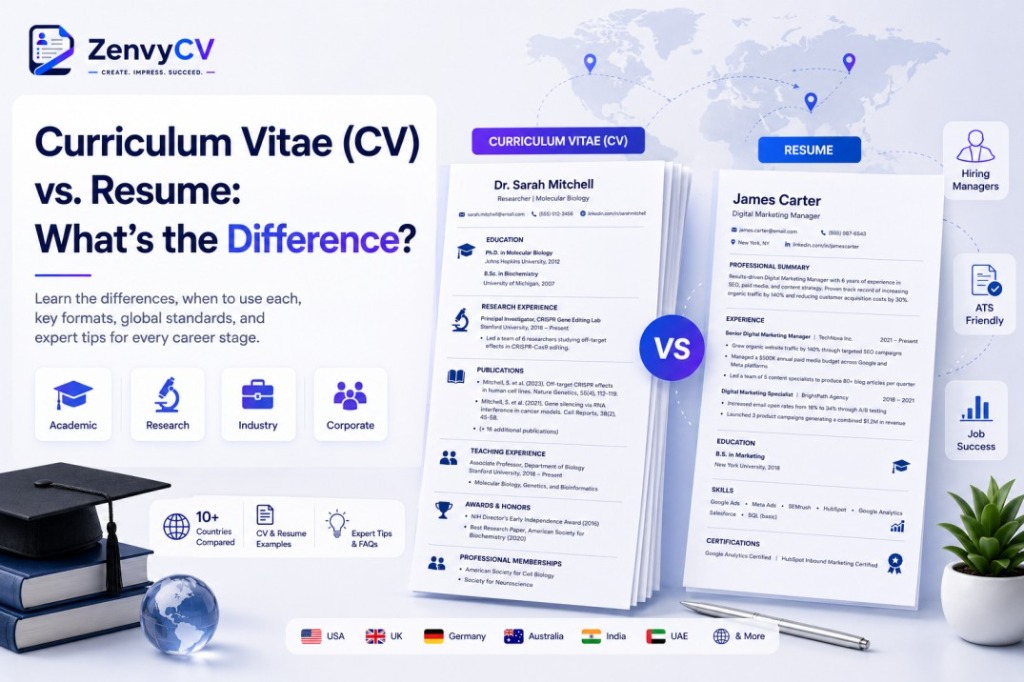
Example of a Curriculum Vitae (CV)
Below is a simplified illustration of what a standard academic CV looks like:
- Led a team of 6 researchers studying off-target effects in CRISPR-Cas9 editing
What is the Format of a Curriculum Vitae (CV)?
A CV follows a structured format that prioritizes academic credentials and professional history in full detail. The standard sections include:
Name, phone, email, and professional website or LinkedIn
A brief overview written as an elevator pitch summarizing your key accomplishments
Degrees listed in reverse-chronological order, including GPA, major, minor, and research focus
Research roles, projects, and labs you have worked in
Courses you have taught, institutions, and dates
Peer-reviewed articles and conference talks cited in APA or MLA format
Grants, fellowships, academic recognition, and memberships in academic or scientific organizations
Software, programming languages, and laboratory tools
For large hiring pools, some organizations initially ask for a condensed CV summary of 1 to 2 pages that covers the highlights of your full CV.
What is a Resume?
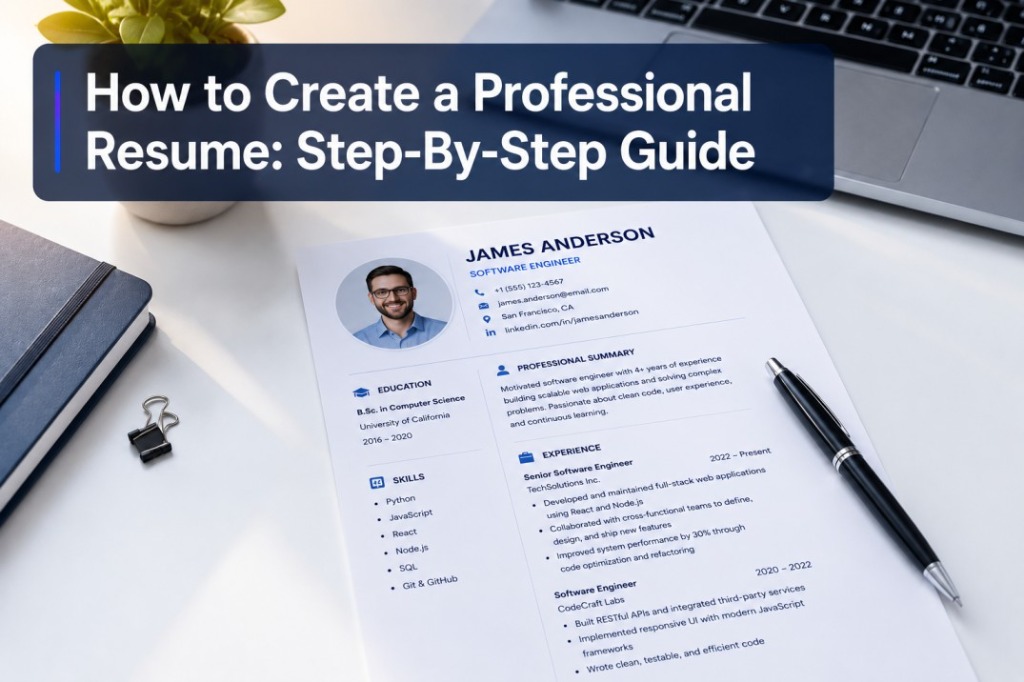
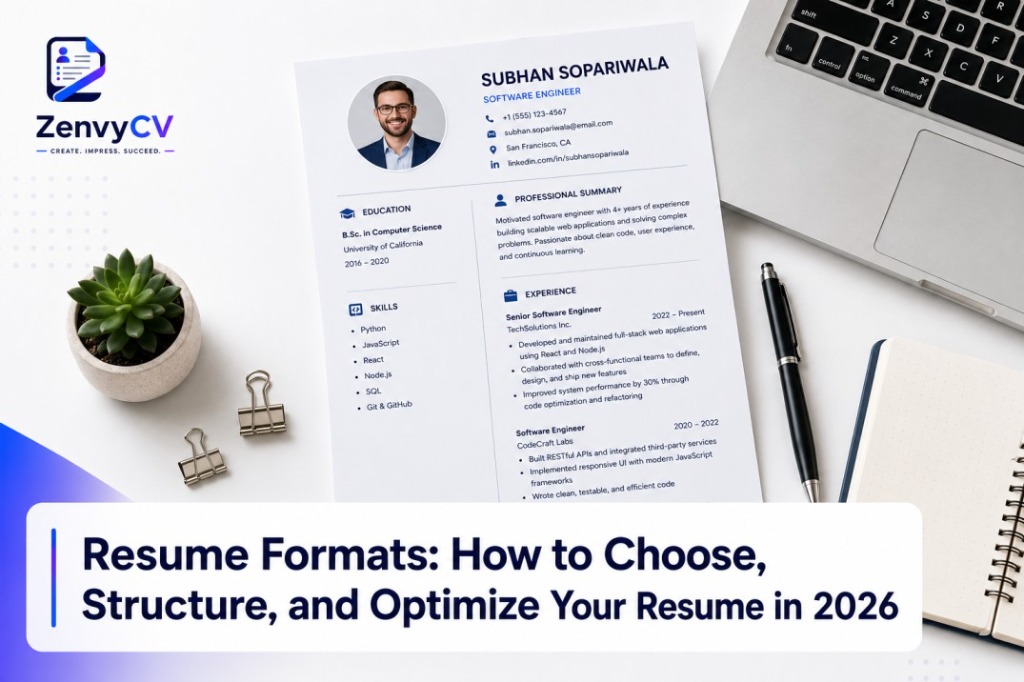
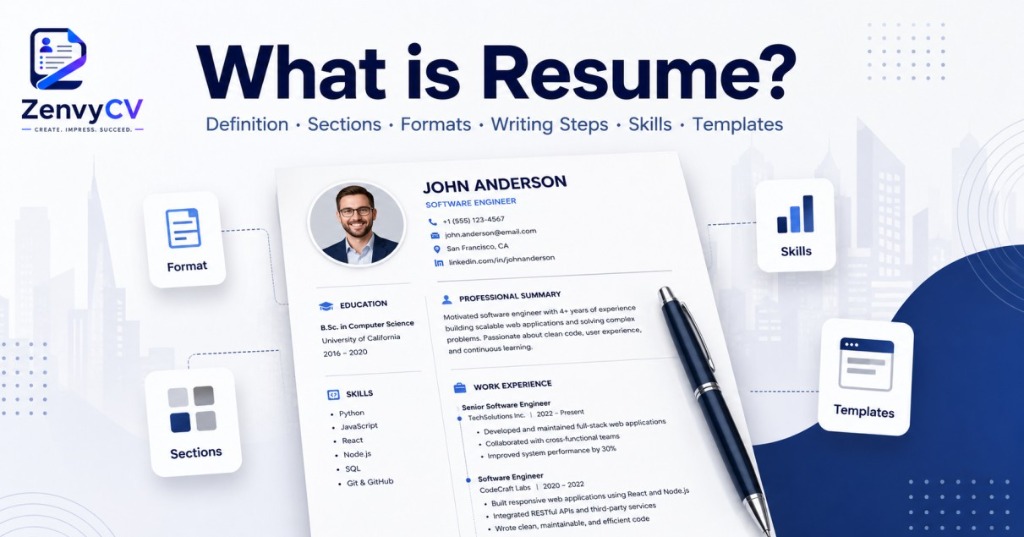
A resume is a short, targeted document built for the purpose of applying to a specific job. It summarizes your education, work history, credentials, and key accomplishments. Resumes are the most common document requested of applicants across the world.
The goal of a resume is to fit your most relevant qualifications onto 1 to 2 pages. It is a personal marketing document designed to show hiring managers exactly why you are the right fit for the role. Every line on a resume should earn its place.
In the United States, resumes are competency-based. They focus on achievement-driven statements, quantified results, and skills that match the specific job description. In 99% of cases, a one-page resume is the target for most applicants, especially those with under 10 years of experience.
Example of a Resume
Below is a simplified example of a strong, job-specific resume:
- Grew organic website traffic by 140% through targeted SEO campaigns
- Managed a $500K annual paid media budget across Google and Meta platforms
- Led a team of 5 content specialists to produce 80+ blog articles per quarter
- Increased email open rates from 18% to 34% through A/B testing
- Launched 3 product campaigns generating a combined $1.2M in revenue
What is the Format of a Resume?
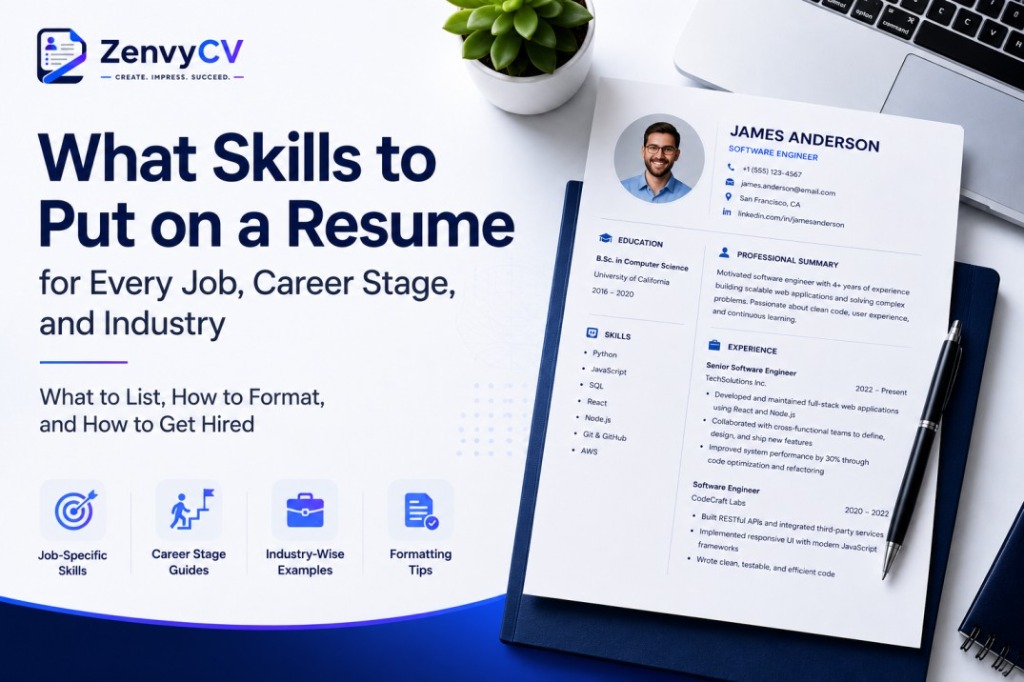
A resume uses a clean, scannable format built for quick review by hiring managers and ATS software. The standard sections include:
- Contact Information: Name, phone number, email, city, and LinkedIn profile URL
- Professional Summary or Objective: 2 to 3 sentences that highlight your value to the employer
- Work Experience: Jobs listed in reverse-chronological order with bullet points for key achievements
- Education: Degree, institution, and graduation year
- Skills: A concise list of hard and soft skills relevant to the role
- Optional Sections: Certifications, volunteer work, languages, or awards
There are three standard resume formats: chronological, functional, and combination (hybrid). Chronological resumes list jobs from newest to oldest and work best for most applicants. Functional resumes lead with skills and work well for career changers. Combination resumes blend both approaches and suit mid-career professionals.
What is the Difference Between CV and Resume?
The primary differences are length, content, and purpose. Here is a clear side-by-side breakdown:
| Feature | CV | Resume |
|---|---|---|
| Length | 3 to 10+ pages | 1 to 2 pages |
| Purpose | Academic, research, medical roles | Corporate and industry jobs |
| Content | Full academic and professional history | Tailored highlights for a specific job |
| Flexibility | Fixed, comprehensive structure | Customized per job application |
| Photo | Rare in US and UK; varies by country | Generally not included |
| Publications | Yes, required | No |
| Personal details | Not in US/UK; varies internationally | Not included |
| Updated | Continuously, as you add achievements | Per job application |
A CV presents your full history of academic accomplishments. A resume presents a concise, curated summary of your qualifications for one specific role. Both are tailored for the position you are applying to, but they are used for entirely different purposes and audiences.
When Should You Use a CV?
Use a CV in these specific situations:
-
✅
Academic roles
Applying for faculty, professorship, or research roles at a university
-
✅
Fellowships and grants
Applying for fellowships, grants, or academic scholarships
-
✅
Graduate school applications
Submitting an application to graduate or doctoral programs
-
✅
Medical and clinical research
Applying for positions in medicine, science, or clinical research
-
✅
International applications
Applying for jobs internationally in countries where a CV is the standard format
If you are applying for both academic and industry positions simultaneously, you will need to prepare and maintain both documents.
When Should You Use a Resume?
Use a resume in these situations:
-
✅
Corporate and private sector roles
Applying for corporate, startup, or private sector roles in any industry
-
✅
Online job portals
Submitting applications through LinkedIn, Indeed, Glassdoor, or similar platforms
-
✅
Career changes
Career changes where you want to highlight transferable skills over a full work history
-
✅
Entry-level roles
Entry-level roles where you do not yet have a long academic record
-
✅
Employer specifies "resume"
Any situation where the employer explicitly asks for a "resume"
-
✅
US, Canada, and Australia
Most job applications in business, industry, and non-profit sectors in these countries
How Do CV and Resume Requirements Differ by Country?
The rules change significantly depending on where you are applying. The same document can be called different things in different countries, and what you include changes too.
United States and Canada
The US and Canada use resumes for most jobs. A CV is reserved for academic, research, and medical roles only. Both countries have strict anti-discrimination laws that discourage including personal details like date of birth, gender, or marital status. A standard US resume is 1 to 2 pages. A US academic CV can run 3 to 15+ pages.
United Kingdom and Ireland
In the UK and Ireland, "CV" is the standard term used for all job applications. When a British employer asks for a CV, they want the equivalent of an American resume: 1 to 2 pages, no photo, no date of birth, and no personal details beyond contact information.
Europe (Germany, France, EU)
Most European countries use the term CV for job applications. Germany expects a passport-style photo and a very structured format. France typically expects a one-page CV with a professional photo. The Europass CV format is accepted across EU member states. In the Netherlands and Scandinavia, formats are closer to the UK standard.
Australia, India, and South Africa
In these countries, the terms CV and resume are used interchangeably. In Australia, the standard length is 2 to 3 pages with no photo expected. In India, CV, resume, and biodata are all commonly used. Private sector roles typically use a resume, while government and public sector roles may require a CV or biodata.
UAE and Middle East
In the UAE, CV is the standard term. UAE CVs often include a photo, nationality, visa status, and date of birth — all of which would be unusual on a UK or US document. A 2 to 3 page CV is common, and references are usually listed directly at the end.
China and Asia
In China, a photo and date of birth are standard inclusions. State-owned companies may require a "political status" field. Foreign companies operating in China generally follow a more international format without this requirement.
Here is a quick country reference table:
| Country | Term Used | Length | Photo |
|---|---|---|---|
| USA | Resume (CV for academia) | 1 to 2 pages | No |
| UK | CV | 1 to 2 pages | No |
| Germany | CV / Lebenslauf | 1 to 2 pages | Yes |
| France | CV | 1 page | Yes |
| Australia | CV or Resume | 2 to 3 pages | No |
| India | CV, Resume, or Biodata | 2 to 3 pages | Optional |
| UAE | CV | 2 to 3 pages | Yes |
| China | CV / Jiànlì | 1 to 2 pages | Yes |
Frequently Asked Questions
Is a CV the same as a resume?
Not always. In most parts of the world, including Europe, the UK, Asia, and Australia, CV and resume mean the same thing and are used interchangeably. In the United States, they are two distinct documents. A US resume is a short, job-specific document of 1 to 2 pages. A US CV is a comprehensive academic document that can run 10 or more pages.
Which is better: CV or resume?
Neither is universally better. The right choice depends on the role and the country. A resume is better for most corporate and industry jobs. A CV is better for academic, research, and medical roles. Using the wrong document for the wrong context can hurt your application regardless of how strong your credentials are.
Can I use a CV instead of a resume?
In most US corporate hiring contexts, no. Submitting a 10-page academic CV for a marketing or sales role would work against you. In countries like the UK or Australia, there is no practical difference because the terms mean the same thing. Always check what the employer asks for and match the format to the context.
Is a CV longer than a resume?
Yes, in the US context. For entry-level academic candidates, a CV is at least 2 to 3 pages. For mid-level and senior researchers with many publications, a CV can run 10 to 15 pages or more. A resume, by contrast, is almost always kept to 1 to 2 pages regardless of experience level.
Should freshers use a CV or resume?
For most entry-level industry jobs, a resume is the right choice. It lets you present your skills, education, and internship experience concisely on one page. Research shows that completing an internship makes you 85% more likely to secure a full-time job after graduation. Freshers applying to academic programs, research labs, or graduate schools may need a CV, even if it is shorter than a seasoned professional's.
Can a resume be two pages?
Yes, in some cases. A resume can be 2 pages for professionals with 10 or more years of relevant experience, multiple certifications, or complex technical backgrounds. Freshers and early-career candidates should stick to one page. As of September 2025, US federal agencies only accept 2-page resumes with no exceptions.
What should I include in a CV?
A complete CV should include contact information, a professional summary or profile, education in reverse-chronological order with GPA and research focus, research experience, teaching experience, publications and conference presentations cited in APA or MLA format, awards and grants, professional memberships, and technical skills. Academic CVs may also include dissertations supervised, funded projects, invited talks, and editorial work. Always list entries from most recent to oldest.
What is the difference between CV, Resume, and Biodata?
These three documents serve different purposes. A resume is a 1 to 2 page targeted document that highlights your most relevant work experience and skills for a specific job. A CV is a comprehensive academic document covering your full professional and scholarly history with no page limit. Biodata, short for "biographical data," is a document primarily used in South Asian countries like India, Pakistan, and Bangladesh. It includes personal details such as date of birth, gender, religion, marital status, and hobbies that neither a CV nor a resume would include in Western markets. Biodata is commonly requested for government jobs, public sector roles, and matrimonial purposes.